Beyond Rules: Understanding Production Context
Unlike legacy systems that rely on rigid, predefined parameters (such as explicit pixel-count thresholds), AI visual inspection systems utilise neural networks to evaluate components much like an experienced human operator—but at superhuman speed. By training on examples of acceptable and defective parts, the software develops an understanding of context. It can accurately distinguish between an inconsequential cosmetic variation (such as a minor surface watermark or a speck of dust) and a critical structural defect like a micro-crack.
From Inspection Checkpoint to Process Insight
The ultimate value of AI-driven vision systems extends far beyond filtering out non-conforming parts. By compiling detailed digital records of every component—complete with time stamps, batch IDs, and precision deviation mapping, these platforms generate continuous, structured quality data.
When integrated into broader Industry 4.0 environments, this information allows manufacturers to track microscopic process drift over time. Production teams can identify tool wear and machine degradation before it results in component failures, effectively transitioning quality control into a strategic asset for continuous process improvement.
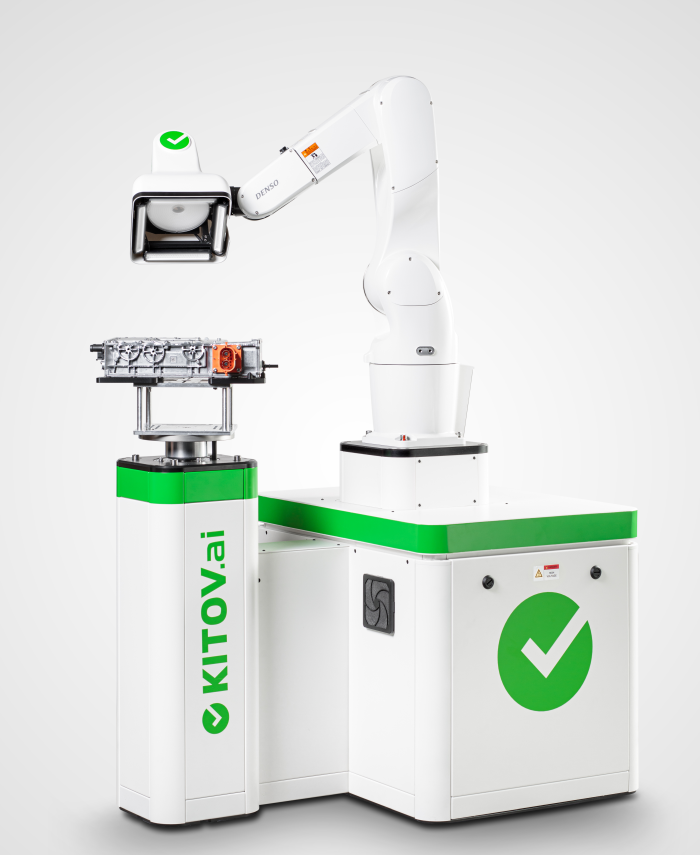
The KITOV CORE and CORE+ systems from Optimax are a ready-to-use visual inspection solutions that combines traditional machine vision techniques, including automated lighting control, deep learning, 2D/3D imaging, and intelligent robotic planning.
Optimax Imaging & Inspection Ltd. Contact: Brian Kyte
Phone: 07984596015
Email: Brian.Kyte@optimaxonline.com