Demand for composites parts is growing rapidly in many major industry sectors as companies strive to source cost-effective manufacturing and lightweight material solutions. The aerospace industry is looking to increase their output rates significantly, at competitive cost while the automotive sector is widely adopting electric propulsion and the emergence of connected vehicles. Thermoplastic composite materials are a critical element for the success due to their rapid process time, coupled with improvements in digital design tools and industrialisation of manufacturing processes. Traditional processing of thermoset composites using autoclaves do not show economies of scale in a higher volume environment.
Over the next 24 months, the National Composites Centre (NCC), based in Bristol, will complete the installation of extensive world-leading capabilities in line with its vision to support the growth of the composites manufacturing industry. This will support industry access to high rate processes for thermoplastic composites, that will accelerate understanding, use and adoption of this technology in industry.
Thermoplastic composites tapes are coming to market in many material formats and polymer resins, and these will rapidly transform the opportunity to design and produce composites solutions in a shorter timeframe, at lower cost, and at higher volumes. These materials also offer advantages in toughness, corrosion resistance and recyclability that work across all sectors, including Oil & Gas. Resin and fibre choice is dependent upon application, melt temperature and cost, with commodity polymer resins such as PP, PA6 and PPS likely to become standard choices for cost-sensitive markets such as automotive, and engineering polymers such as PEEK and PEKK more likely to meet aerospace requirements with higher temperature stability and low moisture absorption.
The NCC has already pioneered use of a high intensity flash-lamp to soften thermoplastic tapes in-situ using the AFP (Automated Fibre Placement) process to lay the tapes down using a flexible automated technology and this is now subject to a patent application. Our additional capabilities being installed shortly includes an Automated Tape Laying (ATL) machine capable of faster application of much wider tapes up to 300 mm wide. Parts made using these processes can be consolidated using presses, which are also in use at the NCC, including a large Schuler press capable of producing very large consolidated parts.
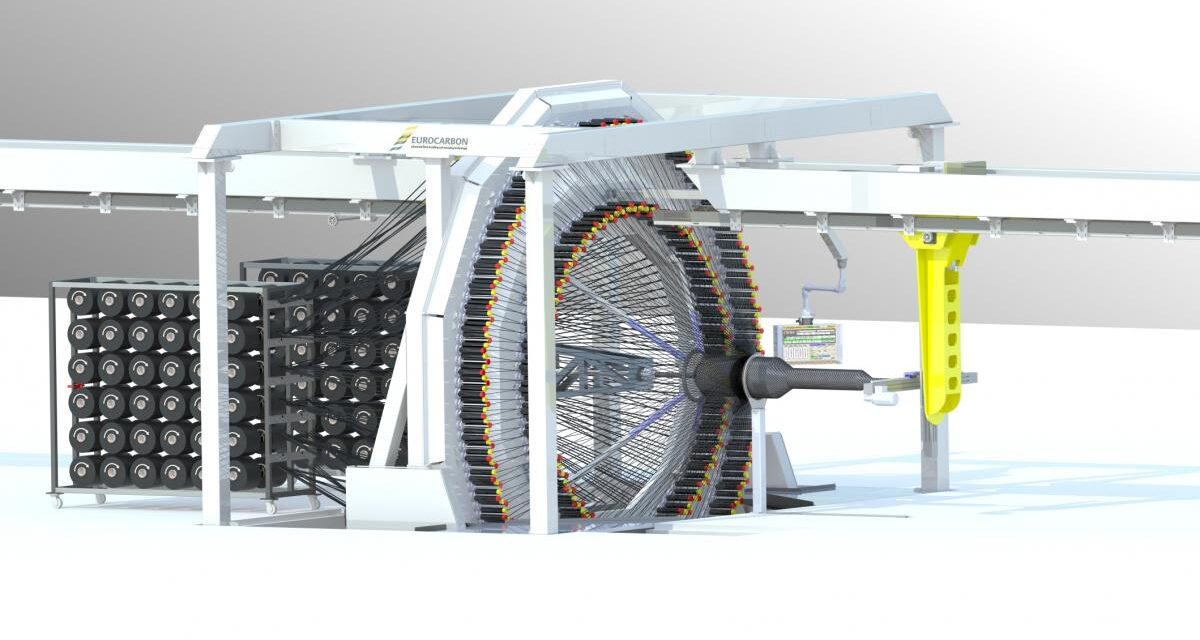
A braiding line capable of producing parts up to 800 mm diameter is also being installed, that will be capable of manufacturing complex tubular net shape preforms with changes of diameter and shape, as well as inserting fibres in multiple axes. This is a potentially high rate, repeatable process, capable of manufacturing high integrity structural parts using co-mingled thermoplastic materials.
Injection over-moulding, such as that being installed at the NCC, can add structural long fibre thermoplastic tapes and laminates in stressed areas, combined with short fibre reinforced material to create local or general features such as ribs and bosses. This technique combines short cycle times approaching 60 seconds with reduced number of process steps, and potentially high repeatability and recyclability to produce the parts with economies of scale. The capability being installed include a large platen injection moulding machine combined with an infra-red oven in a robotised cell.
This process lends itself to medium to high volume applications with high levels of functional integration. The existing injection moulding supply chain is well placed to benefit from this investment, which will be available to businesses to cost effectively develop their applications.
Executive Director, Strategy & Business Development, Alison Starr, explains: “Our approach is to support industrial adoption through developing deep understanding of these processes, allied to modelling, simulation and materials to inform choices. We have the capabilities and know-how to support optimised design and prototyping of new products, as well as maturing process development and pilot production to enable our customers to produce right first time, quality, product at competitive rate and cost.”
More composites needed, quickly