This year, 2018, sees Surface Generation celebrating the culmination of 4 years and £3 million of investment in its patented PtFS process for the production of high performance composites. “Since 2014 we have been developing the core PtFS hardware and control software to support aerospace, automotive, consumer electronic, sporting goods and energy customers particularly in injection and compression moulding,” says Ben Halford, CEO and Founder.
“The world-wide market for flexible digital manufacturing processes is growing rapidly, with companies not wanting to be tied to traditional techniques. PtFS has been designed from the outset to meet this demand for Out of Autoclave (OoA) high volume processing of composites, be they thermoplastic or thermoset, continuous or chopped fibre,” he continues.
The PtFS process offers pixelated control of the mould face temperature that gives users precision localised control. This permits fast and/or slow thermal cycling within the same part, which is critical for use with semi-crystalline polymers, where cooling rates play a key role in the final physical and mechanical properties. The latest 2018 spec PtFS hardware and software now enables the company to offer systems with a ±2.5°C spread during dwell on single sided open-faced tools.
Surface Generation’s in-house produced v.7 Symphony control suite features its Orchestrator programming, Mechanica automation and Biblica data analysis modules and has been developed to make it even easier to use via auto-setup. “The next 2019 version v.8 will be even more powerful as we expand the level of automation and open the Application Programming Interfacing (API) to interact with third party systems including pressure transducers, data loggers, ultrasonic sensors and dielectric cure monitors,” continues Ben Halford.
This integrated approach has recently been demonstrated with considerable success, most notably on the Innovate UK funded collaborative project TOSCAA. This entailed the over-moulding of long-fibre organo-sheet inserts to reduce weight and increase stiffness, when compared to the traditional metal part. By precisely manipulating temperature and flow during injection, this 1 kg automotive structural component was produced using PtFS with only 300 tonnes of clamp force compared to traditional injection mouldings forces of around 900 tonnes.
Surface Generation’s most recent PtFS developments include a freestanding, bench top press-clave, a 64-channel 40 kW control cabinet and a new modular Windfall mould base architecture. The bench top press-clave gives ultimate R&D and short run flexibility, and can happily cure epoxies at 180°C or form thermoplastics at 400°C with full pressure and vacuum control. The 64-channel controller and Windfall mould bases (50, 75 and 100 mm pixel sizes) are aimed at larger surface area products to provide a better economic proposition as customers push OoA processing to the next level.
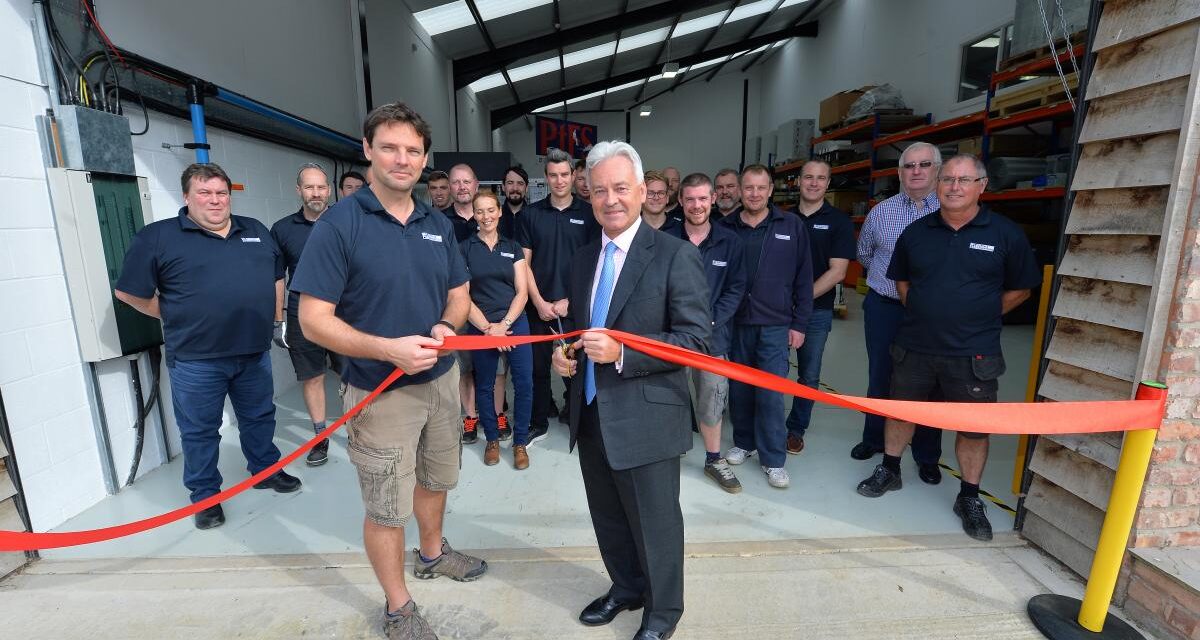
With customers around the world, to support all of this work Surface Generation has recently opened a PtFS Innovation and Application Support Centre at its facility in Rutland. “This will let customers trial and use our technology to mould materials and parts and develop processes, before transferring them into their own facilities,” Ben Halford explains.
Additionally, the company has added a fourth large capacity CNC mill to produce trial mould faces for turnkey solutions. Ben Halford sees a very bright future for Surface Generation, with exploitation of the technology within its traditional markets and further developments in metal and glass forming to come.
-440x264.jpg)